
Writing a book used to mean months of outlining, drafting, editing, formatting, and preparing marketing materials. For a first-time author, the hardest part was often not writing itself. It was figuring out what to do next.
That process has changed.
With ChatGPT, a solo creator can now use one AI assistant to brainstorm a book concept, structure chapters, develop examples, improve the manuscript, create a cover brief, and build a launch plan. You can even use AI image tools to develop visual concepts for the book.
That doesn’t mean ChatGPT can magically produce a bestselling book in 48 hours. A useful book still needs human judgment, fact-checking, editing, and a clear reason for existing. But AI can remove a huge amount of the repetitive work between having an idea and having a finished manuscript.
I’ve found that the biggest improvement comes from using different prompts for different stages of the publishing process, rather than asking AI to “write my book.”
Here are nine prompts you can use as a practical workflow.
1. Validate Your Book Idea Before Writing
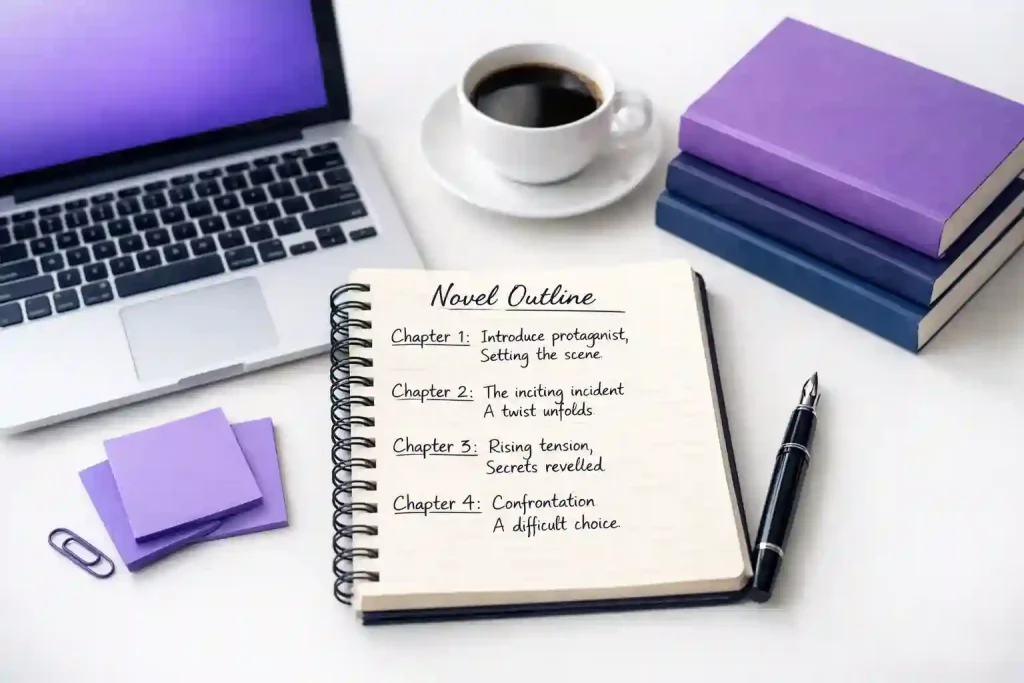
A common mistake is starting with Chapter 1 before deciding whether the idea is actually useful.
Instead, use ChatGPT as an idea validator.
Try this prompt:
Act as a senior publishing strategist with extensive experience evaluating nonfiction book concepts.

My book idea: [describe your idea in one sentence]

My background and expertise: [describe your experience]

Target reader: [describe your ideal reader]

Evaluate this idea based on:
- The problem it solves
- Who is most likely to buy it
- What makes the idea different
- Competing books or approaches
- The strongest promise I can realistically make
- Potential weaknesses
- Possible chapter directions

Tell me what I should change before I start writing.
Do not simply praise the idea. Be critical and practical.
The last instruction matters.
You don’t need an AI that tells you every idea is brilliant. You need one that points out where the concept is weak.
2. Build the Chapter Structure
Once the idea survives the first test, create the architecture.
Act as a professional nonfiction book architect.

Book title: [title]
Core promise: [what transformation does the book provide?]
Target reader: [reader]
Target length: [20,000 words / 40,000 words / etc.]

Create a complete book outline.

For each chapter include:
- Chapter title
- Main purpose
- Key ideas
- Practical examples
- Questions the reader should be able to answer afterward
- Suggested chapter length

Make sure each chapter builds naturally on the previous one.
Avoid repeating the same concept across multiple chapters.
This gives you something more useful than a simple table of contents.
You’re creating a logical path for the reader.
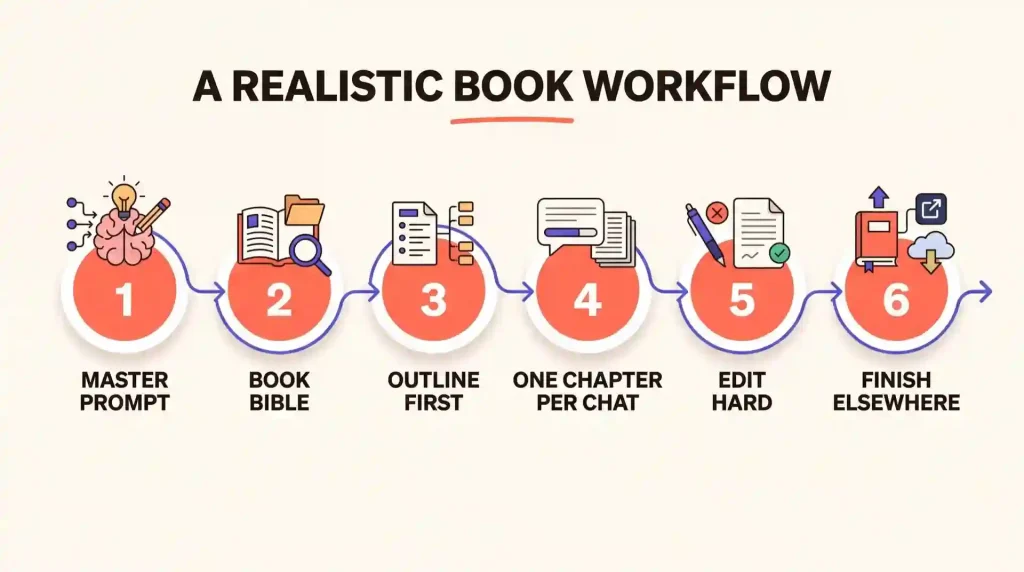
3. Write One Chapter at a Time
Don’t ask AI to generate an entire 40,000-word book in one request.
Large outputs often become repetitive, generic, or inconsistent.
Instead, work chapter by chapter.
Act as an experienced nonfiction ghostwriter.

Book title: [title]
Chapter number: [number]
Chapter title: [title]
Target reader: [reader]
Main lesson: [lesson]

Write this chapter in approximately [X] words.

Requirements:
- Use natural, conversational English
- Explain technical ideas with practical examples
- Avoid unnecessary repetition
- Use specific examples rather than generic motivational statements
- Vary sentence length
- Use clear headings where appropriate
- End with practical actions the reader can take

Do not invent statistics, studies, quotations, or personal experiences.
If information requires verification, clearly mark it for fact-checking.
That final instruction is particularly useful for nonfiction.
AI should help you write the manuscript, but it shouldn’t quietly manufacture evidence.
4. Turn Dry Information Into Memorable Stories
A book can contain excellent information and still be boring.
Stories and examples give readers something they can remember.
Use this prompt:
Act as a storytelling editor who specializes in nonfiction.

Chapter topic: [topic]
Core concept: [concept]
Target reader: [reader]

Create three realistic examples that demonstrate this concept.

For each example include:
- The situation
- The person's problem
- The decision they make
- What happens next
- The lesson for the reader

Keep the examples realistic and clearly label anything fictional.
Do not present invented events as real case studies.
This is especially useful for business, productivity, technology, career, and educational books.
You can then select the strongest example and rewrite it in your own voice.
5. Create the Book Description
After the manuscript exists, you need to explain why someone should read it.
A book description isn’t a summary of every chapter. Its job is to make the right reader interested.
Act as a professional book marketing copywriter.

Book title: [title]
Author background: [your background]
Target reader: [reader]
Reader's main problem: [problem]
Book's promise: [transformation]

Write a professional book description.

Start with a strong opening that identifies the reader's problem.
Then introduce the book's approach without giving away the entire book.

Include:
- Who the book is for
- What readers will learn
- What makes the book useful
- A clear reason to keep reading

Create two versions:
1. A short version
2. A longer version suitable for an online bookstore
Don’t exaggerate your credentials or make claims the book can’t support.
Trust is more valuable than a dramatic sales pitch.
6. Edit the Manuscript With AI
Writing the first draft is only half the job.
The editing stage is where you can make the book substantially better.
Act as a senior nonfiction editor.

Here is my chapter:

[PASTE CHAPTER]

Book tone: [conversational / authoritative / practical / inspiring]
Target reader: [reader]

Edit this chapter for:
- Clarity
- Sentence flow
- Repetition
- Weak explanations
- Unnecessary filler
- Awkward transitions
- Consistent terminology

Preserve my original meaning and personality.

For significant changes, show:
Original:
Revised:
Reason:
This is much better than simply saying “make this sound professional.”
You want the AI to explain why a change improves the text.
7. Create a Cover Design Brief
You don’t necessarily need a professional designer to develop the initial concept.
You can use ChatGPT to turn your idea into a detailed design brief.
Act as a creative director specializing in nonfiction book covers.

Book title: [title]
Subtitle: [subtitle]
Category: [category]
Target reader: [reader]

Create three different cover concepts.

For each concept describe:
- Main visual idea
- Character or object placement
- Background
- Typography style
- Color direction
- Visual hierarchy
- Emotional impression
- Why it would appeal to the target reader

Keep the design simple enough to remain readable as a small online thumbnail.
You can then take the strongest concept into Canva or an image-generation tool and develop the actual cover.
8. Build a Book Launch Plan
A finished manuscript isn’t the same thing as a launched book.
Create a practical launch schedule before publication.
Act as a book launch strategist.

Book title: [title]
Publication date: [date]
Existing audience: [email subscribers / social followers / website visitors]
Budget: [budget]
Primary goal: [sales / authority / leads / audience growth]

Create a launch plan covering:

- 30 days before launch
- 14 days before launch
- 7 days before launch
- Launch day
- First 30 days after launch

Include:
- Content ideas
- Email campaigns
- Social media posts
- Early reader outreach
- Review strategy
- Launch metrics to track

Prioritize actions that can be completed by a solo author.
This helps prevent the classic mistake of finishing the book and only then asking, “How do I get anyone to read it?”
9. Turn One Book Into Multiple Revenue Streams
A book doesn’t have to be the final product.
It can become the foundation for other products and services.
Act as a publishing business strategist.

Book title: [title]
Core topic: [topic]
Target audience: [audience]

Identify practical ways this book could generate revenue beyond direct book sales.

Consider:
- Ebook
- Print book
- Audiobook
- Templates
- Worksheets
- Online courses
- Consulting
- Coaching
- Memberships
- Workshops
- Corporate training
- Related digital products

For each option explain:
- Why it fits the audience
- Difficulty to create
- Approximate time required
- Potential revenue model
- How the book could lead customers toward it

Rank the opportunities from easiest to hardest to launch.
This changes the way you think about a book.
Instead of treating it as a single product, you can treat it as one piece of a larger content business.
A Practical 48-Hour Workflow
If you already know your subject well, you can move surprisingly quickly.
A realistic intensive workflow could look like this:
Hours 1–4: Validate the idea and define the reader.
Hours 4–8: Build the outline and chapter structure.
Hours 8–24: Draft the first version chapter by chapter.
Hours 24–32: Add examples, stories, exercises, and missing sections.
Hours 32–40: Edit and fact-check the manuscript.
Hours 40–44: Create the title, subtitle, description, and cover concept.
Hours 44–48: Prepare formatting, metadata, publishing files, and launch materials.
That is a workflow target, not a guarantee. A short practical guide may be possible in this timeframe. A research-heavy book, technical reference, or serious nonfiction title will require much more time.
The important point is that AI can dramatically reduce the mechanical work.
Common Mistakes When Using ChatGPT to Write a Book
Asking for the whole book at once
This usually produces inconsistent chapters and repetitive ideas.
Work in smaller sections.
Accepting everything AI writes
AI-generated text can contain factual errors, weak reasoning, outdated information, and invented details.
You remain the editor.
Trying to sound like a famous author
Don’t ask AI to imitate a living author’s exact style. Instead, describe the characteristics you want: conversational, concise, humorous, technical, analytical, or story-driven.
Publishing without human editing
Readers can usually tell when a book hasn’t been properly reviewed.
Read the manuscript yourself. Check facts. Verify statistics. Remove generic passages and add your own experience.
Focusing only on writing
A book also needs a useful title, strong description, readable formatting, appropriate metadata, and a realistic distribution strategy.
The Real Advantage of AI-Assisted Publishing
The biggest change isn’t that ChatGPT can “write a book.”
It’s that one person can now handle many tasks that previously required several different specialists.
You can use AI for research organization, outlining, drafting, editing, brainstorming, marketing, and planning while keeping the important decisions in human hands.
If you have genuine knowledge about a subject, the combination becomes even more useful.
Don’t aim to have AI replace the author. Use it to remove the work that gets in the author’s way.
That is what can turn a book idea sitting in a notebook into a finished publishing project much faster than before.